WORKSTREAM 3
Brand search connected to inventory
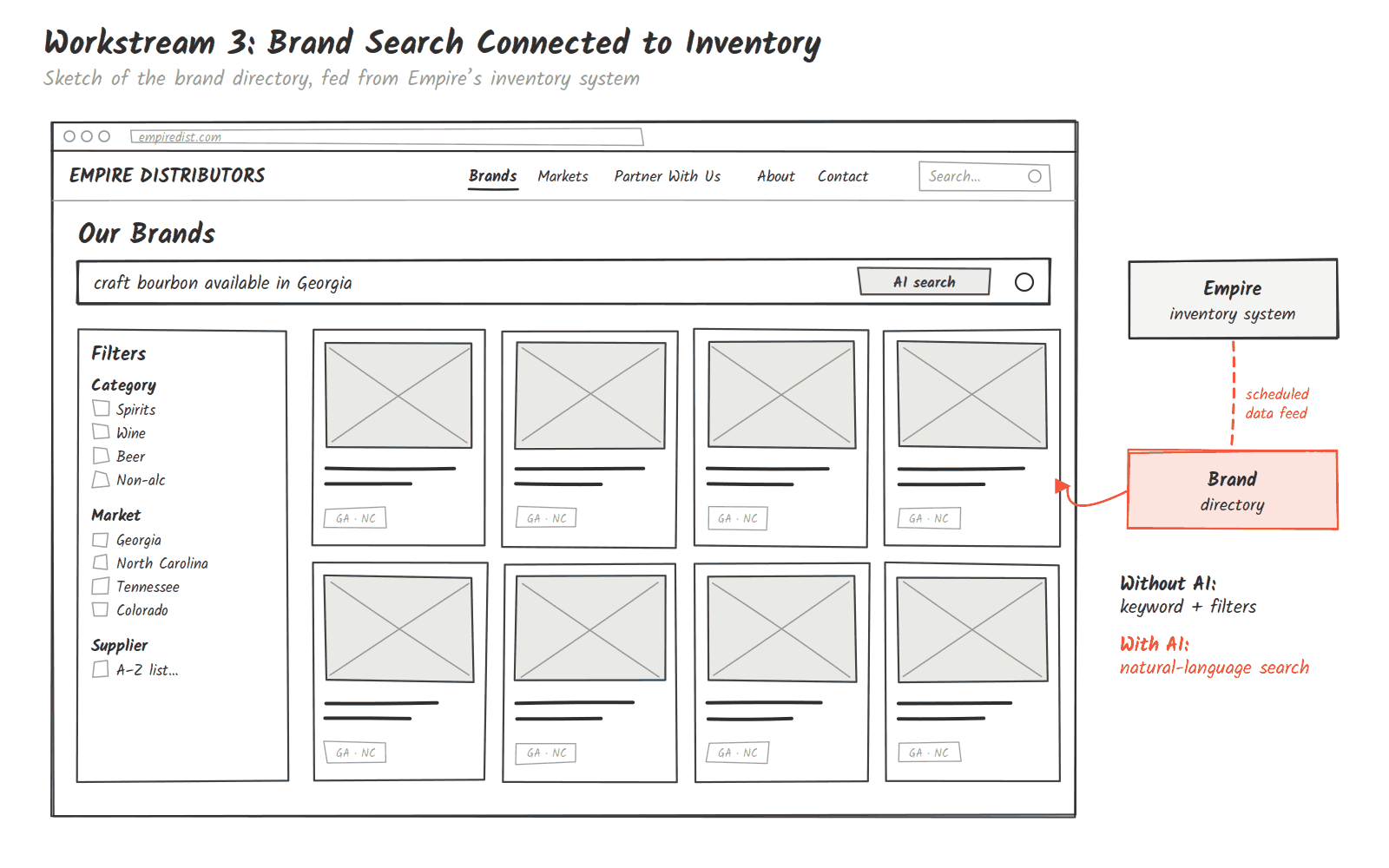
A searchable, filterable brand directory, so supplier prospects can see which brands Empire carries and in which markets.
- Natural-language search, for example “craft bourbon brands in Georgia”
- A scheduled data feed from Empire’s inventory system
- Brand listing and detail pages
How it works
- Inventory systemEmpire’s source of brand data
- Scheduled data feedSmall service outside WordPress
- WordPressEach brand stored as a record
- Brand directorySearch and filter by category, supplier and market
Brand data flows one way, from Empire’s inventory system into WordPress on a schedule. The directory reads only from WordPress, so the website never depends on the inventory system being available.
$17,000 to $25,500
For your IT team
How the feed connects to the inventory system
We confirm the method in discovery, after reviewing the inventory system and a sample data extract.
- APIWhen it applies: the system exposes brand or item data with secure access.Effect on effort: within range.
- Scheduled file export (CSV via SFTP or shared folder)When it applies: no API, but the system can export data on a schedule.Effect on effort: within range.
- Vendor-built extract or undocumented APIWhen it applies: access exists but needs vendor work.Effect on effort: upper end of range, or a change request.
- Manual uploadWhen it applies: no automated access is available.Effect on effort: an admin upload screen replaces the automated feed.
Why the feed runs outside WordPress
- Ready for the future: if Empire moves to Xperience by Kentico (Option C), the feed and its data-quality rules carry over unchanged. Only the final step changes.
- Site performance: the feed and any AI search processing run outside the website, so they don’t compete for the current hosting’s resources.
- Flexible hosting: the service can run on whichever cloud platform fits Empire’s environment, chosen during discovery.
Assumptions
- The inventory system provides brand-level data (brand, supplier, category and market) through an API or a scheduled export, at least daily.
- Building a custom extract inside the inventory system is not included.
- The directory shows brands and the markets they are sold in. It does not show live stock or pricing.
- The directory covers up to 1,000 brands.
- Empire supplies brand logos and descriptions. Records missing required information are held back or shown with a placeholder, per rules agreed in discovery.
- The integration service runs on a cloud platform chosen in discovery. Hosting costs are billed to Empire.
- Empire names a technical contact for the inventory system.
Risks and how we handle them
- Inventory system API availabilityWhy it matters: the system may only export files, need vendor approval or fees, or sit on-premises.Mitigation: discovery with a sample extract before fixed pricing, and the feed priced by integration method.
- Data kept by item, not brandWhy it matters: inventory systems track products, so brands need a rollup and categories need supplier-friendly names.Mitigation: brand and category mapping agreed with Empire in discovery.
- Brand data qualityWhy it matters: missing logos, descriptions, categories or markets, duplicates and discontinued brands leave the directory incomplete.Mitigation: data-quality rules, an exceptions report, and placeholder or hold-back rules.
- Feed overwriting website editsWhy it matters: marketing changes could be lost on the next update.Mitigation: agreed field ownership. The feed writes only its own fields.
- Hosting capacityWhy it matters: search, filter and AI requests are not cached and share the current hosting’s resources.Mitigation: a capacity check in discovery. The feed and AI processing run outside the website.
- AI result quality (Option B)Why it matters: wrong or irrelevant results reduce trust.Mitigation: keyword fallback, testing against real questions, and tuning before launch.